Thursday, 20 July 2017

GEOMETRIC TOOLS - DESCRIPTIONS AND USES

We come across a number of shapes in our day to day life. You are already aware of a couple of them such as triangles, squares, hexagons, circles, parallelograms and so on. Different figures have characteristic properties such as length, breadth, diameter, etc. which set them apart from one another and are parameters to produce the figures on paper. Practical geometry is the most pragmatic branch of geometry that deals with the construction of different geometrical figures using geometric tools such as rulers, compasses and protractors. In this article, we list the basic geometric tools, their description and uses.

Geometric Tools and Their Uses
The early geometer studied figures such as points, lines and angles which required the use of rulers and compasses only. With the advent of more geometric designs, other geometric tools were invented. Some of the most commonly used geometric tools are:
  • The Ruler: Also known as the straightedge, a ruler is used to construct straight lines and measure the lengths of a line segment. It is a straight edge originally used only for drawing straight lines. However, for our convenience, it is graduated into centimeters and millimeters on one side, and into inches on the other.


  • The Compasses: It is a ‘V’-shaped tool which holds a pencil on the one side of the ‘V’ and a pointer on the other side. The distance between the pencil and the pointer is adjustable. It is used to trace arcs, circles and angles. It is also used to mark equal lengths.


  • The Protractor: It is a semi-circular disc used to draw and measure angles. It is graduated from 0 to 180 degrees and can be directly used to measure any angle within its range. It has two set of markings, 0 to 180 degrees from left to right and vice versa.


  • The Divider: It looks similar to the compasses with its ‘V’-shaped structure. However, it has pointers on both ends of the ‘V’. The distance between them is adjustable and it is used to measure and compare lengths.


  • The Set-Squares: These are the triangular pieces of plastic with some portion between them removed. There are two kinds of set squares available in the market. One has the angles 45, 45 and 90 degrees at the 3 vertices while the other has 30, 60 and 90 degree angles. They are used to draw parallel and perpendicular lines.


Thursday, 13 July 2017

MATHEMATICIANS

FATHER OF MATHEMATICS -ARCHIMEDES


FATHER OF ALGEBRA -ABU JAAFAR MOHAMMAD IBN MOUSA AL KHWARIZMI


FATHER OF STATISTICS – ROBERT FISHER


FATHER OF TRIGONOMETRY - HIPPARCHUS


FATHER OF GEOMETRY - EUCLID


FATHER OF SETS – GEORG CANTOR


FATHER OF NUMBER THEORY – PIERRE DE 

FERMAT


FATHER OF GRAPH THEORY – LEONHARD

EULER


Sunday, 9 July 2017

THE IMPORTANCE OF MATHEMATICS IN EVERYDAY LIFE

Mathematics is a methodical application of matter. It is so said because the subject makes a man methodical or systematic. Mathematics makes our life orderly and prevents chaos. Certain qualities that are nurtured by mathematics are power of reasoning, creativity, abstract or spatial thinking, critical thinking, problem-solving ability and even effective communication skills.
Mathematics is the cradle of all creations, without which the world cannot move an inch. Be it a cook or a farmer, a carpenter or a mechanic, a shopkeeper or a doctor, an engineer or a scientist, a musician or a magician, everyone needs mathematics in their day-to-day life. Even insects use mathematics in their everyday life for existence.

Snails make their shells, spiders design their webs, and bees build hexagonal combs. There are countless examples of mathematical patterns in nature's fabric. Anyone can be a mathematician if one is given proper guidance and training in the formative period of one's life. A good curriculum of mathematics is helpful in effective teaching and learning of the subject.

Experience says learning mathematics can be made easier and enjoyable if our curriculum includes mathematical activities and games. Maths puzzles and riddles encourage and attract an alert and open-minded attitude among youngsters and help them develop clarity in their thinking. Emphasis should be laid on development of clear concept in mathematics in a child, right from the primary classes.

If a teacher fails here, then the child will develop a phobia for the subject as he moves on to the higher classes. For explaining a topic in mathematics, a teacher should take help of pictures, sketches, diagrams and models as far as possible. As it is believed that the process of learning is complete if our sense of hearing is accompanied by our sense of sight. Open-ended questions should be given to the child to answer and he/she should be encouraged to think about the solutions in all possible manners. The child should be appreciated for every correct attempt. And the mistakes must be immediately corrected without any criticism.


The greatest hurdle in the process of learning mathematics is lack of practice. Students should daily work out at least 10 problems from different areas in order to master the concept and develop speed and accuracy in solving a problem. Learning of multiplication-tables should be encouraged in the lower classes.
Another very effective means of spreading the knowledge of mathematics among children is through peer-teaching. Once a child has learned a concept from his teacher, the latter should ask him to explain the same to fellow students. Moreover, in the process all the children will be able to express their doubts on the topic and clear them through discussions in a group.


The present age is one of skill-development and innovations. The more mathematical we are in our approach, the more successful we will be. Mathematics offers rationality to our thoughts. It is a tool in our hands to make our life simpler and easier. Let us realize and appreciate the beauty of the subject and embrace it with all our heart. It is a talent which should be compulsorily honed by all in every walk of life.

Thursday, 6 July 2017

ALGEBRA AND GEOMETRY WITH CALCULS

One of the earliest algebra topics learned is how to find the slope of a line--a numerical value that describes just how slanted that line is. Calculus gives us a much more generalized method of finding slopes. With it, we can find not only how steeply a line slopes, but indeed, how steeply any curve slopes at any given point.
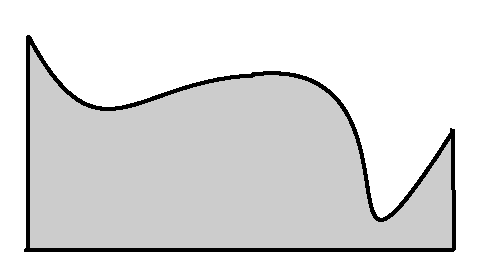
Without calculus, it is difficult to find areas of shapes other than those whose formulas you learned in geometry. You may be able to find the area of commons shapes such as a triangle, square, rectangle, circle, and even a trapezoid; but how could you find the area of the shape like the one shown below?
With calculus, you can calculate complicated x-intercepts. Without a graphing calculator, it is pretty difficult to calculate an irrational root. However, a simple process called Newton's Method (named Isaac Newton) allows you to calculate an irrational root to whatever accuracy you want.
Calculus makes it much easier to visualize graphs. You may already have a good grasp of linear functions and how to visualize their graphs easily, but what about the graph of something like y= x^3 + 2x^2 - x + 1? Elementary calculus tells you exactly where that graph will be increasing, decreasing, and twisting. You can even find the highest and lowest points on the graph without plotting a single point.
One of the most useful applications of calculus is the optimization of functions. In a small number of steps, you can answer questions such as:
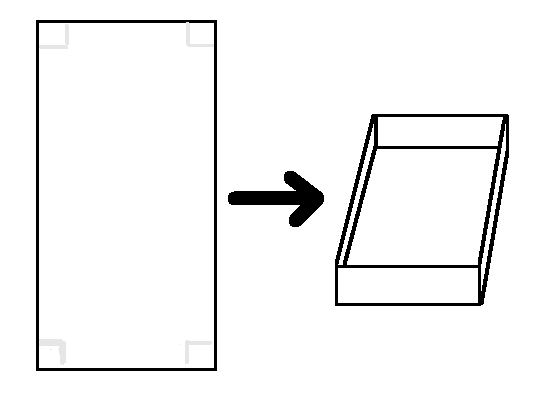
If I have 500 feet of fence, what is the largest rectangular yard I can make? or Given a rectangular sheet of paper which measures 8.5 inches by 11 inches, what are the dimensions of the box I can make containing the greatest volume?
The traditional way to create an open box from a rectangular surface is to cut congruent squares from the corners of the rectangle and then to fold the resulting sides up as shown:
Calculus develops concepts in other mathematics that lets us discover more about them and enables us to achieve greater feats than the mathematics that it is built on. It is vital to understanding and making sense of the world we live in.

Wednesday, 28 June 2017

APPLICATIONS OF CALCULUS

With calculus, we have the ability to find the effects of changing conditions on a system. By studying these, you can learn how to control a system to make it do what you want it to do. Because of the ability to model and control systems, calculus gives us extraordinary power over the material world.
Calculus is the language of engineers, scientists, and economists. The work of these professionals has a huge impact on our daily life - from your microwaves, cell phones, TV, and car to medicine, economy, and national defense.
Credit card companies use calculus to set the minimum payments due on credit card statements at the exact time the statement is processed by considering multiple variables such as changing interest rates and a fluctuating available balance.
Biologists use differential calculus to determine the exact rate of growth in a bacterial culture when different variables such as temperature and food source are changed. This research can help increase the rate of growth of necessary bacteria, or decrease the rate of growth for harmful and potentially threatening bacteria.
An electrical engineer uses integration to determine the exact length of power cable needed to connect two substations that are miles apart. Because the cable is hung from poles, it is constantly curving. Calculus allows a precise figure to be determined.
An architect will use integration to determine the amount of materials necessary to construct a curved dome over a new sports arena, as well as calculate the weight of that dome and determine the type of support structure required.
Space flight engineers frequently use calculus when planning lengthy missions. To launch an exploratory probe, they must consider the different orbiting velocities of the Earth and the planet the probe is targeted for, as well as other gravitational influences like the sun and the moon. Calculus allows each of those variables to be accurately taken into account.
Statisticians will use calculus to evaluate survey data to help develop business plans for different companies. Because a survey involves many different questions with a range of possible answers, calculus allows a more accurate prediction for appropriate action.
physicist uses calculus to find the center of mass of a sports utility vehicle to design appropriate safety features that must adhere to federal specifications on different road surfaces and at different speeds.
An operations research analyst will use calculus when observing different processes at a manufacturing corporation. By considering the value of different variables, they can help a company improve operating efficiency, increase production, and raise profits.
graphics artist uses calculus to determine how different three-dimensional models will behave when subjected to rapidly changing conditions. This can create a realistic environment for movies or video games.
Obviously, a wide variety of careers regularly use calculus. Universities, the military, government agencies, airlines, entertainment studios, software companies, and construction companies are only a few employers who seek individuals with a solid knowledge of calculus. Even doctors and lawyers use calculus to help build the discipline necessary for solving complex problems, such as diagnosing patients or planning a prosecution case. Despite its mystique as a more complex branch of mathematics, calculus touches our lives each day, in ways too numerous to calculate.

Thursday, 22 June 2017

PRACTICAL APPLICATIONS OF ALGEBRA

It's easy to think of algebra as an abstract notion that has no use in real life. Understanding the history and the practical applications of algebra that are put into use every day might make you see it a little differently.
The main idea behind algebra is to replace numbers (or other specific objects) by symbols. This makes things a lot simpler: instead of saying "I’m looking for a number so that when I multiply it by 7 and add 3 I get 24", you simply write 7x+3=24, where x is the unknown number.
Algebra is a huge area in mathematics, and there are many mathematicians who spend their time thinking about what you can do with collections of abstract symbols. In real life, however, algebra merges into all other areas as a tool. Whenever life throws a maths problem at you, for example when you have to solve an equation or work out a geometrical problem, algebra is usually the best way to attack it. The equations you are learning about now are the ones that you're most likely to come across in everyday life. This means that knowing how to solve them is very useful. If you're planning to go into computer programming, however, the algebra you'll need is more complicated and now's the time to make sure you get the basics.
Did you know? The word algebra comes from the ancient Arabic word "al jebr", which  means the "reunion of broken parts".

Solving equations

We have already seen how practical applications of algebra can be used to solve equations. You will often see equations like 3x+4=5, where you want to find x.
Using algebra, you can give a recipe for solving any equation of this form:
if ax+b=c, then x=(c-b)/a.
So whenever you have to solve one of these, you don’t have to go through the whole process of rearranging the equation. Instead you can just plug your numbers a, b and c into the recipe and get the answer. Read the linear equation to see a practical application of algebra that you might already be familiar with.

Algebra in Geometry

Two-dimensional shapes can be represented using a co-ordinate system. Saying that a point has the co-ordinates (4,2) for example, means that we get to that point by taking four steps into the horizontal direction and 2 in the vertical direction, starting from the point where the two axes meet.
Using algebra, we can represent a general point by the co-ordinates (x,y). You may have already learnt that a straight line is represented by an equation that looks like y=mx+b, for some fixed numbers m and b. There are similar equations that describe circles and more complicated curves. Using these algebraic expressions, we can compute lots of things without ever having to draw the shapes. For example we can find out if and where a circle and a straight line meet, or whether one circle lies inside another one.

Algebra in computer programming

As we have seen, algebra is about recognising general patterns. Rather than looking at the two equations 3x+1=5 and 6x+2=3 as two completely different things, Algebra sees them as being examples of the same general equation ax+b=c. Specific numbers have been replaced by symbols.
Computer programming languages, like C++ or Java, work along similar lines. Inside the computer, a character in a computer game is nothing but a string of symbols. The programmer has to know how to present the character in this way. Moreover, he or she only has a limited number of commands to tell the computer what to do with this string. Computer programming is all about representing a specific context, like a game, by abstract symbols. A small set of abstract rules is used to make the symbols interact in the right way. Doing this requires algebra.


Thursday, 15 June 2017

APPLICATION OF FRACTIONS IN OUR REAL LIFE

Finding Fractions Around You

We don't want you thinking that you will only use fractions in math classes. Fractions are around you every day of the week. Do you know about that container of milk in your refrigerator? It is probably a half gallon. Drinks you buy in the store might come in half-liter bottles. When you want to buy some food at the deli, you might ask for a quarter or half a pound. Your parents probably think about how much gas they have every day. It's great to have a full tank, but they also know if they have three quarters, a half, or a quarter of a tank left. 

Those examples are easy to imagine, but what about adding fractions and multiplying fractions? In the fraction word problems section, we told you about pieces of pie at a party. If a pie has six pieces, you need to know if you have enough food for everyone. What about drinks? If you have a half gallon of water, will it be enough for everyone to get two glasses each? It's all about fractions. 

Construction

We admit that the decimal system is easier for measurements, but the United States still uses inches and feet to make measurements. If you want to build a table, you might need to have it six feet two and a quarter inches long (6' 2 1/4"). Let's say you cut the board too long and your boss says, "Cut off a sixteenth of an inch." You need to know how long that is or everything gets messed up. 

You could also have a day when you need to buy a piece of plywood. You might need five pieces that are thirteen and five eighths of an inch long. How much plywood would you need? You'll be multiplying fractions to get those numbers. (5 x 13 5/8 = ?) 

Cooking

We talked about measuring in construction. Cooking is the same. You need to measure things whenever you follow a recipe. You have half-cups, quarters of a teaspoon, and a whole bunch of other measurements. Your cookbook might only have recipes that serve two people. What if you have some friends over? What if you're a professional chef and you are making food for a party? You will need to do a bunch of multiplication so that your food comes out right. You'll also need to work with fractions to find out if you have enough food in the pantry or if you need to buy more. 

Fractions and Ratios in Science

This won't be a surprise, but fractions and ratios are used in science. Luckily, most of science has moved to the decimal system when it comes to measuring amounts. You will still need fractions if you are counting things. Let's say you are working with colonies of bacteria. You will need to count the numbers of different bacteria in a dish. You could get 6 of one species, 3 of another species, and 4 of a third species. Where are the fractions? You actually have 6/13, 3/13, and 4/13 in that dish. Those values can tell you a lot about how bacteria reproduce and survive.