Wednesday, 28 June 2017

APPLICATIONS OF CALCULUS

With calculus, we have the ability to find the effects of changing conditions on a system. By studying these, you can learn how to control a system to make it do what you want it to do. Because of the ability to model and control systems, calculus gives us extraordinary power over the material world.
Calculus is the language of engineers, scientists, and economists. The work of these professionals has a huge impact on our daily life - from your microwaves, cell phones, TV, and car to medicine, economy, and national defense.
Credit card companies use calculus to set the minimum payments due on credit card statements at the exact time the statement is processed by considering multiple variables such as changing interest rates and a fluctuating available balance.
Biologists use differential calculus to determine the exact rate of growth in a bacterial culture when different variables such as temperature and food source are changed. This research can help increase the rate of growth of necessary bacteria, or decrease the rate of growth for harmful and potentially threatening bacteria.
An electrical engineer uses integration to determine the exact length of power cable needed to connect two substations that are miles apart. Because the cable is hung from poles, it is constantly curving. Calculus allows a precise figure to be determined.
An architect will use integration to determine the amount of materials necessary to construct a curved dome over a new sports arena, as well as calculate the weight of that dome and determine the type of support structure required.
Space flight engineers frequently use calculus when planning lengthy missions. To launch an exploratory probe, they must consider the different orbiting velocities of the Earth and the planet the probe is targeted for, as well as other gravitational influences like the sun and the moon. Calculus allows each of those variables to be accurately taken into account.
Statisticians will use calculus to evaluate survey data to help develop business plans for different companies. Because a survey involves many different questions with a range of possible answers, calculus allows a more accurate prediction for appropriate action.
A physicist uses calculus to find the center of mass of a sports utility vehicle to design appropriate safety features that must adhere to federal specifications on different road surfaces and at different speeds.
An operations research analyst will use calculus when observing different processes at a manufacturing corporation. By considering the value of different variables, they can help a company improve operating efficiency, increase production, and raise profits.
A graphics artist uses calculus to determine how different three-dimensional models will behave when subjected to rapidly changing conditions. This can create a realistic environment for movies or video games.
Obviously, a wide variety of careers regularly use calculus. Universities, the military, government agencies, airlines, entertainment studios, software companies, and construction companies are only a few employers who seek individuals with a solid knowledge of calculus. Even doctors and lawyers use calculus to help build the discipline necessary for solving complex problems, such as diagnosing patients or planning a prosecution case. Despite its mystique as a more complex branch of mathematics, calculus touches our lives each day, in ways too numerous to calculate.

Thursday, 22 June 2017

PRACTICAL APPLICATIONS OF ALGEBRA

It's easy to think of algebra as an abstract notion that has no use in real life. Understanding the history and the practical applications of algebra that are put into use every day might make you see it a little differently.
The main idea behind algebra is to replace numbers (or other specific objects) by symbols. This makes things a lot simpler: instead of saying "I’m looking for a number so that when I multiply it by 7 and add 3 I get 24", you simply write 7x+3=24, where x is the unknown number.
Algebra is a huge area in mathematics, and there are many mathematicians who spend their time thinking about what you can do with collections of abstract symbols. In real life, however, algebra merges into all other areas as a tool. Whenever life throws a maths problem at you, for example when you have to solve an equation or work out a geometrical problem, algebra is usually the best way to attack it. The equations you are learning about now are the ones that you're most likely to come across in everyday life. This means that knowing how to solve them is very useful. If you're planning to go into computer programming, however, the algebra you'll need is more complicated and now's the time to make sure you get the basics.
Did you know? The word algebra comes from the ancient Arabic word "al jebr", which  means the "reunion of broken parts".

Solving equations

We have already seen how practical applications of algebra can be used to solve equations. You will often see equations like 3x+4=5, where you want to find x.
Using algebra, you can give a recipe for solving any equation of this form:
if ax+b=c, then x=(c-b)/a.
So whenever you have to solve one of these, you don’t have to go through the whole process of rearranging the equation. Instead you can just plug your numbers a, b and c into the recipe and get the answer. Read the linear equation to see a practical application of algebra that you might already be familiar with.

Algebra in Geometry

Two-dimensional shapes can be represented using a co-ordinate system. Saying that a point has the co-ordinates (4,2) for example, means that we get to that point by taking four steps into the horizontal direction and 2 in the vertical direction, starting from the point where the two axes meet.
Using algebra, we can represent a general point by the co-ordinates (x,y). You may have already learnt that a straight line is represented by an equation that looks like y=mx+b, for some fixed numbers m and b. There are similar equations that describe circles and more complicated curves. Using these algebraic expressions, we can compute lots of things without ever having to draw the shapes. For example we can find out if and where a circle and a straight line meet, or whether one circle lies inside another one.

Algebra in computer programming

As we have seen, algebra is about recognising general patterns. Rather than looking at the two equations 3x+1=5 and 6x+2=3 as two completely different things, Algebra sees them as being examples of the same general equation ax+b=c. Specific numbers have been replaced by symbols.
Computer programming languages, like C++ or Java, work along similar lines. Inside the computer, a character in a computer game is nothing but a string of symbols. The programmer has to know how to present the character in this way. Moreover, he or she only has a limited number of commands to tell the computer what to do with this string. Computer programming is all about representing a specific context, like a game, by abstract symbols. A small set of abstract rules is used to make the symbols interact in the right way. Doing this requires algebra.


Thursday, 15 June 2017

APPLICATION OF FRACTIONS IN OUR REAL LIFE

Finding Fractions Around You

We don't want you thinking that you will only use fractions in math classes. Fractions are around you every day of the week. Do you know about that container of milk in your refrigerator? It is probably a half gallon. Drinks you buy in the store might come in half-liter bottles. When you want to buy some food at the deli, you might ask for a quarter or half a pound. Your parents probably think about how much gas they have every day. It's great to have a full tank, but they also know if they have three quarters, a half, or a quarter of a tank left. 

Those examples are easy to imagine, but what about adding fractions and multiplying fractions? In the fraction word problems section, we told you about pieces of pie at a party. If a pie has six pieces, you need to know if you have enough food for everyone. What about drinks? If you have a half gallon of water, will it be enough for everyone to get two glasses each? It's all about fractions. 

Construction

We admit that the decimal system is easier for measurements, but the United States still uses inches and feet to make measurements. If you want to build a table, you might need to have it six feet two and a quarter inches long (6' 2 1/4"). Let's say you cut the board too long and your boss says, "Cut off a sixteenth of an inch." You need to know how long that is or everything gets messed up. 

You could also have a day when you need to buy a piece of plywood. You might need five pieces that are thirteen and five eighths of an inch long. How much plywood would you need? You'll be multiplying fractions to get those numbers. (5 x 13 5/8 = ?) 

Cooking

We talked about measuring in construction. Cooking is the same. You need to measure things whenever you follow a recipe. You have half-cups, quarters of a teaspoon, and a whole bunch of other measurements. Your cookbook might only have recipes that serve two people. What if you have some friends over? What if you're a professional chef and you are making food for a party? You will need to do a bunch of multiplication so that your food comes out right. You'll also need to work with fractions to find out if you have enough food in the pantry or if you need to buy more. 

Fractions and Ratios in Science

This won't be a surprise, but fractions and ratios are used in science. Luckily, most of science has moved to the decimal system when it comes to measuring amounts. You will still need fractions if you are counting things. Let's say you are working with colonies of bacteria. You will need to count the numbers of different bacteria in a dish. You could get 6 of one species, 3 of another species, and 4 of a third species. Where are the fractions? You actually have 6/13, 3/13, and 4/13 in that dish. Those values can tell you a lot about how bacteria reproduce and survive. 

Monday, 10 April 2017

HOW MATHEMATICS USED IN OTHER SUBJECT?

Science

Science and math are intimately connected, particularly in fields such as chemistry, astronomy and physics. Students who can't master basic arithmetic skills will struggle to read scientific charts and graphs. More complex math, such as geometry, algebra and calculus, can help students solve chemistry problems, understand the movements of the planets and analyze scientific studies. Math is also important in practical sciences, such as engineering and computer science. Students may have to solve equations when writing programs.

Literature and Writing

Literature might seem like a far cry from math, but mastering basic arithmetic can enable students to better understand poetry. The meter of poetry, the number of words to include in a line and the effect that certain rhythms have on the reader are all products of mathematical calculations. At a more mundane level, math can help students plan reading assignments in literature classes by discerning their average reading time and estimating how long it will take them to read a particular work. The linear, logical thinking used in mathematical problems can also help students write more clearly and logically.

Social Studies

Social studies classes, such as history, often require students to review charts and graphs that provide historical data or information on ethnic groups. In geography classes, students might need to understand how the elevation of an area affects its population or chart the extent to which different populations have different average life spans. Knowledge of basic mathematical terms and formulas makes statistical information accessible.

The Arts

Students interested in pursuing careers in theater, music, dance or art can benefit from basic mathematical knowledge. Musical rhythm often follows complex mathematical series, and math can help students learn the basic rhythms of dances used in ballet and theater performances. Art thrives on geometry, and students who understand basic geometric formulas can craft impressive art pieces.

Thursday, 6 April 2017

HISTORY OF PYTHAGORAS

It is sometimes claimed that we owe pure mathematics to Pythagoras, and he is often called the first "true" mathematician. But, although his contribution was clearly important, he nevertheless remains a controversial figure. He left no mathematical writings himself, and much of what we know about Pythagorean thought comes to us from the writings of Philolaus and other later Pythagorean scholars. Indeed, it is by no means clear whether many (or indeed any) of the theorems ascribed to him were in fact solved by Pythagoras personally or by his followers.
The school he established at Croton in southern Italy around 530 BCE was the nucleus of a rather bizarre Pythagorean sect. Although Pythagorean thought was largely dominated by mathematics, it was also profoundly mystical, and Pythagoras imposed his quasi-religious philosophies, strict vegetarianism, communal living, secret rites and odd rules on all the members of his school (including bizarre and apparently random edicts about never urinating towards the sun, never marrying a woman who wears gold jewellery, never passing an ass lying in the street, never eating or even touching black fava beans, etc) .
The members were divided into the "mathematikoi" (or "learners"), who extended and developed the more mathematical and scientific work that Pythagoras himself began, and the "akousmatikoi" (or "listeners"), who focused on the more religious and ritualistic aspects of his teachings. There was always a certain amount of friction between the two groups and eventually the sect became caught up in some fierce local fighting and ultimately dispersed. Resentment built up against the secrecy and exclusiveness of the Pythagoreans and, in 460 BCE, all their meeting places were burned and destroyed, with at least 50 members killed in Croton alone.
The over-riding dictum of Pythagoras's school was “All is number” or “God is number”, and the Pythagoreans effectively practised a kind of numerology or number-worship, and considered each number to have its own character and meaning. For example, the number one was the generator of all numbers; two represented opinion; three, harmony; four, justice; five, marriage; six, creation; seven, the seven planets or “wandering stars”; etc. Odd numbers were thought of as female and even numbers as male.
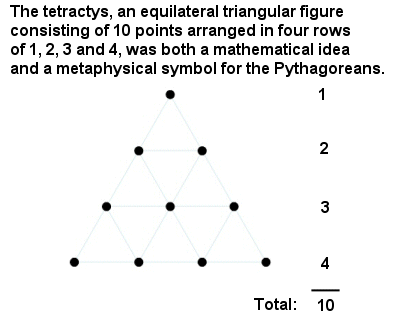
The holiest number of all was "tetractys" or ten, a triangular number composed of the sum of one, two, three and four. It is a great tribute to the Pythagoreans' intellectual achievements that they deduced the special place of the number 10 from an abstract mathematical argument rather than from something as mundane as counting the fingers on two hands.
However, Pythagoras and his school - as well as a handful of other mathematicians of ancient Greece - was largely responsible for introducing a more rigorous mathematics than what had gone before, building from first principles using axioms and logic. Before Pythagoras, for example, geometry had been merely a collection of rules derived by empirical measurement. Pythagoras discovered that a complete system of mathematics could be constructed, where geometric elements corresponded with numbers, and where integers and their ratios were all that was necessary to establish an entire system of logic and truth.
He is mainly remembered for what has become known as Pythagoras’ Theorem (or the Pythagorean Theorem): that, for any right-angled triangle, the square of the length of the hypotenuse (the longest side, opposite the right angle) is equal to the sum of the square of the other two sides (or “legs”). Written as an equation: a2 + b2 = c2. What Pythagoras and his followers did not realize is that this also works for any shape: thus, the area of a pentagon on the hypotenuse is equal to the sum of the pentagons on the other two sides, as it does for a semi-circle or any other regular (or even irregular( shape.
The simplest and most commonly quoted example of a Pythagorean triangle is one with sides of 3, 4 and 5 units (32 + 42 = 52, as can be seen by drawing a grid of unit squares on each side as in the diagram at right), but there are a potentially infinite number of other integer “Pythagorean triples”, starting with (5, 12 13), (6, 8, 10), (7, 24, 25), (8, 15, 17), (9, 40, 41), etc. It should be noted, however that (6, 8, 10) is not what is known as a “primitive” Pythagorean triple, because it is just a multiple of (3, 4, 5).
Pythagoras’ Theorem and the properties of right-angled triangles seems to be the most ancient and widespread mathematical development after basic arithmetic and geometry, and it was touched on in some of the most ancient mathematical texts from Babylon and Egypt, dating from over a thousand years earlier. One of the simplest proofs comes from ancient China, and probably dates from well before Pythagoras' birth. It was Pythagoras, though, who gave the theorem its definitive form, although it is not clear whether Pythagoras himself definitively proved it or merely described it. Either way, it has become one of the best-known of all mathematical theorems, and as many as 400 different proofs now exist, some geometrical, some algebraic, some involving advanced differential equations, etc.
It soom became apparent, though, that non-integer solutions were also possible, so that an isosceles triangle with sides 1, 1 and √2, for example, also has a right angle, as the Babylonians had discovered centuries earlier. However, when Pythagoras’s student Hippasus tried to calculate the value of √2, he found that it was not possible to express it as a fraction, thereby indicating the potential existence of a whole new world of numbers, the irrational numbers (numbers that can not be expressed as simple fractions of integers). This discovery rather shattered the elegant mathematical world built up by Pythagoras and his followers, and the existence of a number that could not be expressed as the ratio of two of God's creations (which is how they thought of the integers) jeopardized the cult's entire belief system.
Poor Hippasus was apparently drowned by the secretive Pythagoreans for broadcasting this important discovery to the outside world. But the replacement of the idea of the divinity of the integers by the richer concept of the continuum, was an essential development in mathematics. It marked the real birth of Greek geometry, which deals with lines and planes and angles, all of which are continuous and not discrete.
Among his other achievements in geometry, Pythagoras (or at least his followers, the Pythagoreans) also realized that the sum of the angles of a triangle is equal to two right angles (180°), and probably also the generalization which states that the sum of the interior angles of a polygon with n sides is equal to (2n - 4) right angles, and that the sum of its exterior angles equals 4 right angles. They were able to construct figures of a given area, and to use simple geometrical algebra, for example to solve equations such as a(a - x) = x2by geometrical means.
The Pythagoreans also established the foundations of number theory, with their investigations of triangular, square and also perfect numbers (numbers that are the sum of their divisors). They discovered several new properties of square numbers, such as that the square of a number n is equal to the sum of the first n odd numbers (e.g. 42 = 16 = 1 + 3 + 5 + 7). They also discovered at least the first pair of amicable numbers, 220 and 284 (amicable numbers are pairs of numbers for which the sum of the divisors of one number equals the other number, e.g. the proper divisors of 220 are 1, 2, 4, 5, 10, 11, 20, 22, 44, 55 and 110, of which the sum is 284; and the proper divisors of 284 are 1, 2, 4, 71, and 142, of which the sum is 220).
Pythagoras is also credited with the discovery that the intervals between harmonious musical notes always have whole number ratios. For instance, playing half a length of a guitar string gives the same note as the open string, but an octave higher; a third of a length gives a different but harmonious note; etc. Non-whole number ratios, on the other hand, tend to give dissonant sounds. In this way, Pythagoras described the first four overtones which create the common intervals which have become the primary building blocks of musical harmony: the octave (1:1), the perfect fifth (3:2), the perfect fourth (4:3) and the major third (5:4). The oldest way of tuning the 12-note chromatic scale is known as Pythagorean tuning, and it is based on a stack of perfect fifths, each tuned in the ratio 3:2.
The mystical Pythagoras was so excited by this discovery that he became convinced that the whole universe was based on numbers, and that the planets and stars moved according to mathematical equations, which corresponded to musical notes, and thus produced a kind of symphony, the “Musical Universalis” or “Music of the Spheres”.

Thursday, 30 March 2017

HOW ARE MATRICES USED IN REAL LIFE


In everyday applications, matrices are used to represent real-world data, such as the traits and habits of a certain population. They are used in geology to measure seismic waves. Matrices are rectangular arrangements of expressions, numbers and symbols that are arranged in columns and rows. Matrices have "m" number of rows and "n" number of columns, and numbers in a matrix are called entities or entries.

Matrices are common tools used by the science and research industry to track, record and display the results of research. In addition to applied science, matrices are also used in the basic sciences. For example, physicists use matrices to study optics, electrical circuits and quantum mechanics. The discipline of physics also uses matrices to calculate battery power outputs and resistor conversion of electrical energy into a more efficient form. Matrices are used to solve problems involving Kirchoff's laws of voltage and current. Computer science also relies heavily on matrices. Tasks such as projecting a three-dimensional image onto a two-dimensional screen and encrypting message codes are two areas in which matrices are used. Matrices and their inverses are necessary for programmers to code encrypted messages, and these codes are used to run Internet programs, such as search systems.

Saturday, 25 March 2017

MATHS TRICK IN MULTIPLICATION

1. Multiplying by 9, or 99, or 999
Multiplying by 9 is really multiplying by 10-1.
So, 9x9 is just 9x(10-1) which is 9x10⁻⁹ which is 90-9 or 81.
Let's try a harder example: 46x9 = 46x10-46 = 460-46 = 414.
One more example: 68x9 = 680-68 = 612.
To multiply by 99, you multiply by 100-1.
So, 46x99 = 46x(100-1) = 4600-46 = 4554.
Multiplying by 999 is similar to multiplying by 9 and by 99.
38x999 = 38x(1000-1) = 38000-38 = 37962.
2. Multiplying by 11
To multiply a number by 11 you add pairs of numbers next to each other, except for the numbers on the edges.
Let me illustrate:
To multiply 436 by 11 go from right to left.
First write down the 6 then add 6 to its neighbor on the left, 3, to get 9.
Write down 9 to the left of 6.
Then add 4 to 3 to get 7. Write down 7.
Then, write down the leftmost digit, 4.
So, 436x11 = is 4796.
Let's do another example: 3254x11.
The answer comes from these sums and edge numbers: (3)(3+2)(2+5)(5+4)(4) = 35794.
One more example, this one involving carrying: 4657x11.
Write down the sums and edge numbers: (4)(4+6)(6+5)(5+7)(7).
Going from right to left we write down 7.
Then we notice that 5+7=12.
So we write down 2 and carry the 1.
6+5 = 11, plus the 1 we carried = 12.
So, we write down the 2 and carry the 1.
4+6 = 10, plus the 1 we carried = 11.
So, we write down the 1 and carry the 1.
To the leftmost digit, 4, we add the 1 we carried.
So, 4657x11 = 51227 .
3. Multiplying by 5, 25, or 125
Multiplying by 5 is just multiplying by 10 and then dividing by 2. Note: To multiply by 10 just add a 0 to the end of the number.
12x5 = (12x10)/2 = 120/2 = 60.
Another example: 64x5 = 640/2 = 320.
And, 4286x5 = 42860/2 = 21430.
To multiply by 25 you multiply by 100 (just add two 0's to the end of the number) then divide by 4, since 100 = 25x4. Note: to divide by 4 your can just divide by 2 twice, since 2x2 = 4.
64x25 = 6400/4 = 3200/2 = 1600.
58x25 = 5800/4 = 2900/2 = 1450.
To multiply by 125, you multipy by 1000 then divide by 8 since 8x125 = 1000. Notice that 8 = 2x2x2. So, to divide by 1000 add three 0's to the number and divide by 2 three times.
32x125 = 32000/8 = 16000/4 = 8000/2 = 4000.
48x125 = 48000/8 = 24000/4 = 12000/2 = 6000.
4. Multiplying together two numbers that differ by a small even number
This trick only works if you've memorized or can quickly calculate the squares of numbers. If you're able to memorize some squares and use the tricks described later for some kinds of numbers you'll be able to quickly multiply together many pairs of numbers that differ by 2, or 4, or 6.
Let's say you want to calculate 12x14.
When two numbers differ by two their product is always the square of the number in between them minus 1.
12x14 = (13x13)-1 = 168.
16x18 = (17x17)-1 = 288.
99x101 = (100x100)-1 = 10000-1 = 9999
If two numbers differ by 4 then their product is the square of the number in the middle (the average of the two numbers) minus 4.
11x15 = (13x13)-4 = 169-4 = 165.
13x17 = (15x15)-4 = 225-4 = 221.
If the two numbers differ by 6 then their product is the square of their average minus 9.
12x18 = (15x15)-9 = 216.
17x23 = (20x20)-9 = 391.
5. Squaring 2-digit numbers that end in 5
If a number ends in 5 then its square always ends in 25. To get the rest of the product take the left digit and multiply it by one more than itself.
35x35 ends in 25. We get the rest of the product by multiplying 3 by one more than 3. So, 3x4 = 12 and that's the rest of the product. Thus, 35x35 = 1225.
To calculate 65x65, notice that 6x7 = 42 and write down 4225 as the answer.
85x85: Calculate 8x9 = 72 and write down 7225.
6. Multiplying together 2-digit numbers where the first digits are the same and the last digits sum to 10
Let's say you want to multiply 42 by 48. You notice that the first digit is 4 in both cases. You also notice that the other digits, 2 and 8, sum to 10. You can then use this trick: multiply the first digit by one more than itself to get the first part of the answer and multiply the last digits together to get the second (right) part of the answer.
An illustration is in order:
To calculate 42x48: Multiply 4 by 4+1. So, 4x5 = 20. Write down 20.
Multiply together the last digits: 2x8 = 16. Write down 16.
The product of 42 and 48 is thus 2016.
Notice that for this particular example you could also have noticed that 42 and 48 differ by 6 and have applied technique number 4.
Another example: 64x66. 6x7 = 42. 4x6 = 24. The product is 4224.
A final example: 86x84. 8x9 = 72. 6x4 = 24. The product is 7224
7. Squaring other 2-digit numbers
Let's say you want to square 58. Square each digit and write a partial answer. 5x5 = 25. 8x8 = 64. Write down 2564 to start. Then, multiply the two digits of the number you're squaring together, 5x8=40.
Double this product: 40x2=80, then add a 0 to it, getting 800.
Add 800 to 2564 to get 3364.
This is pretty complicated so let's do more examples.
32x32. The first part of the answer comes from squaring 3 and 2.
3x3=9. 2x2 = 4. Write down 0904. Notice the extra zeros. It's important that every square in the partial product have two digits.
Multiply the digits, 2 and 3, together and double the whole thing. 2x3x2 = 12.
Add a zero to get 120. Add 120 to the partial product, 0904, and we get 1024.
56x56. The partial product comes from 5x5 and 6x6. Write down 2536.
5x6x2 = 60. Add a zero to get 600.
56x56 = 2536+600 = 3136.
One more example: 67x67. Write down 3649 as the partial product.
6x7x2 = 42x2 = 84. Add a zero to get 840.
67x67=3649+840 = 4489.
8. Multiplying by doubling and halving
There are cases when you're multiplying two numbers together and one of the numbers is even. In this case you can divide that number by two and multiply the other number by 2. You can do this over and over until you get to multiplication this is easy for you to do.
Let's say you want to multiply 14 by 16. You can do this:
14x16 = 28x8 = 56x4 = 112x2 = 224.
Another example: 12x15 = 6x30 = 6x3 with a 0 at the end so it's 180.
48x17 = 24x34 = 12x68 = 6x136 = 3x272 = 816. (Being able to calculate that 3x27 = 81 in your head is very helpful for this problem.)
9. Multiplying by a power of 2
To multiply a number by 2, 4, 8, 16, 32, or some other power of 2 just keep doubling the product as many times as necessary. If you want to multiply by 16 then double the number 4 times since 16 = 2x2x2x2.
15x16: 15x2 = 30. 30x2 = 60. 60x2 = 120. 120x2 = 240.
23x8: 23x2 = 46. 46x2 = 92. 92x2 = 184.
54x8: 54x2 = 108. 108x2 = 216. 216x2 = 432.
Practice these tricks and you'll get good at solving many different kinds of arithmetic problems in your head, or at least quickly on paper.