Thursday, 6 April 2017

HISTORY OF PYTHAGORAS

It is sometimes claimed that we owe pure mathematics to Pythagoras, and he is often called the first "true" mathematician. But, although his contribution was clearly important, he nevertheless remains a controversial figure. He left no mathematical writings himself, and much of what we know about Pythagorean thought comes to us from the writings of Philolaus and other later Pythagorean scholars. Indeed, it is by no means clear whether many (or indeed any) of the theorems ascribed to him were in fact solved by Pythagoras personally or by his followers.
The school he established at Croton in southern Italy around 530 BCE was the nucleus of a rather bizarre Pythagorean sect. Although Pythagorean thought was largely dominated by mathematics, it was also profoundly mystical, and Pythagoras imposed his quasi-religious philosophies, strict vegetarianism, communal living, secret rites and odd rules on all the members of his school (including bizarre and apparently random edicts about never urinating towards the sun, never marrying a woman who wears gold jewellery, never passing an ass lying in the street, never eating or even touching black fava beans, etc) .
The members were divided into the "mathematikoi" (or "learners"), who extended and developed the more mathematical and scientific work that Pythagoras himself began, and the "akousmatikoi" (or "listeners"), who focused on the more religious and ritualistic aspects of his teachings. There was always a certain amount of friction between the two groups and eventually the sect became caught up in some fierce local fighting and ultimately dispersed. Resentment built up against the secrecy and exclusiveness of the Pythagoreans and, in 460 BCE, all their meeting places were burned and destroyed, with at least 50 members killed in Croton alone.
The over-riding dictum of Pythagoras's school was “All is number” or “God is number”, and the Pythagoreans effectively practised a kind of numerology or number-worship, and considered each number to have its own character and meaning. For example, the number one was the generator of all numbers; two represented opinion; three, harmony; four, justice; five, marriage; six, creation; seven, the seven planets or “wandering stars”; etc. Odd numbers were thought of as female and even numbers as male.
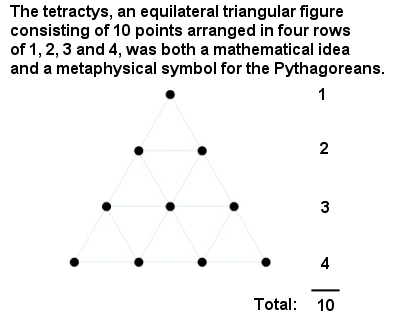
The holiest number of all was "tetractys" or ten, a triangular number composed of the sum of one, two, three and four. It is a great tribute to the Pythagoreans' intellectual achievements that they deduced the special place of the number 10 from an abstract mathematical argument rather than from something as mundane as counting the fingers on two hands.
However, Pythagoras and his school - as well as a handful of other mathematicians of ancient Greece - was largely responsible for introducing a more rigorous mathematics than what had gone before, building from first principles using axioms and logic. Before Pythagoras, for example, geometry had been merely a collection of rules derived by empirical measurement. Pythagoras discovered that a complete system of mathematics could be constructed, where geometric elements corresponded with numbers, and where integers and their ratios were all that was necessary to establish an entire system of logic and truth.
He is mainly remembered for what has become known as Pythagoras’ Theorem (or the Pythagorean Theorem): that, for any right-angled triangle, the square of the length of the hypotenuse (the longest side, opposite the right angle) is equal to the sum of the square of the other two sides (or “legs”). Written as an equation: a2 + b2 = c2. What Pythagoras and his followers did not realize is that this also works for any shape: thus, the area of a pentagon on the hypotenuse is equal to the sum of the pentagons on the other two sides, as it does for a semi-circle or any other regular (or even irregular( shape.
The simplest and most commonly quoted example of a Pythagorean triangle is one with sides of 3, 4 and 5 units (32 + 42 = 52, as can be seen by drawing a grid of unit squares on each side as in the diagram at right), but there are a potentially infinite number of other integer “Pythagorean triples”, starting with (5, 12 13), (6, 8, 10), (7, 24, 25), (8, 15, 17), (9, 40, 41), etc. It should be noted, however that (6, 8, 10) is not what is known as a “primitive” Pythagorean triple, because it is just a multiple of (3, 4, 5).
Pythagoras’ Theorem and the properties of right-angled triangles seems to be the most ancient and widespread mathematical development after basic arithmetic and geometry, and it was touched on in some of the most ancient mathematical texts from Babylon and Egypt, dating from over a thousand years earlier. One of the simplest proofs comes from ancient China, and probably dates from well before Pythagoras' birth. It was Pythagoras, though, who gave the theorem its definitive form, although it is not clear whether Pythagoras himself definitively proved it or merely described it. Either way, it has become one of the best-known of all mathematical theorems, and as many as 400 different proofs now exist, some geometrical, some algebraic, some involving advanced differential equations, etc.
It soom became apparent, though, that non-integer solutions were also possible, so that an isosceles triangle with sides 1, 1 and √2, for example, also has a right angle, as the Babylonians had discovered centuries earlier. However, when Pythagoras’s student Hippasus tried to calculate the value of √2, he found that it was not possible to express it as a fraction, thereby indicating the potential existence of a whole new world of numbers, the irrational numbers (numbers that can not be expressed as simple fractions of integers). This discovery rather shattered the elegant mathematical world built up by Pythagoras and his followers, and the existence of a number that could not be expressed as the ratio of two of God's creations (which is how they thought of the integers) jeopardized the cult's entire belief system.
Poor Hippasus was apparently drowned by the secretive Pythagoreans for broadcasting this important discovery to the outside world. But the replacement of the idea of the divinity of the integers by the richer concept of the continuum, was an essential development in mathematics. It marked the real birth of Greek geometry, which deals with lines and planes and angles, all of which are continuous and not discrete.
Among his other achievements in geometry, Pythagoras (or at least his followers, the Pythagoreans) also realized that the sum of the angles of a triangle is equal to two right angles (180°), and probably also the generalization which states that the sum of the interior angles of a polygon with n sides is equal to (2n - 4) right angles, and that the sum of its exterior angles equals 4 right angles. They were able to construct figures of a given area, and to use simple geometrical algebra, for example to solve equations such as a(a - x) = x2by geometrical means.
The Pythagoreans also established the foundations of number theory, with their investigations of triangular, square and also perfect numbers (numbers that are the sum of their divisors). They discovered several new properties of square numbers, such as that the square of a number n is equal to the sum of the first n odd numbers (e.g. 42 = 16 = 1 + 3 + 5 + 7). They also discovered at least the first pair of amicable numbers, 220 and 284 (amicable numbers are pairs of numbers for which the sum of the divisors of one number equals the other number, e.g. the proper divisors of 220 are 1, 2, 4, 5, 10, 11, 20, 22, 44, 55 and 110, of which the sum is 284; and the proper divisors of 284 are 1, 2, 4, 71, and 142, of which the sum is 220).
Pythagoras is also credited with the discovery that the intervals between harmonious musical notes always have whole number ratios. For instance, playing half a length of a guitar string gives the same note as the open string, but an octave higher; a third of a length gives a different but harmonious note; etc. Non-whole number ratios, on the other hand, tend to give dissonant sounds. In this way, Pythagoras described the first four overtones which create the common intervals which have become the primary building blocks of musical harmony: the octave (1:1), the perfect fifth (3:2), the perfect fourth (4:3) and the major third (5:4). The oldest way of tuning the 12-note chromatic scale is known as Pythagorean tuning, and it is based on a stack of perfect fifths, each tuned in the ratio 3:2.
The mystical Pythagoras was so excited by this discovery that he became convinced that the whole universe was based on numbers, and that the planets and stars moved according to mathematical equations, which corresponded to musical notes, and thus produced a kind of symphony, the “Musical Universalis” or “Music of the Spheres”.

Thursday, 30 March 2017

HOW ARE MATRICES USED IN REAL LIFE


In everyday applications, matrices are used to represent real-world data, such as the traits and habits of a certain population. They are used in geology to measure seismic waves. Matrices are rectangular arrangements of expressions, numbers and symbols that are arranged in columns and rows. Matrices have "m" number of rows and "n" number of columns, and numbers in a matrix are called entities or entries.

Matrices are common tools used by the science and research industry to track, record and display the results of research. In addition to applied science, matrices are also used in the basic sciences. For example, physicists use matrices to study optics, electrical circuits and quantum mechanics. The discipline of physics also uses matrices to calculate battery power outputs and resistor conversion of electrical energy into a more efficient form. Matrices are used to solve problems involving Kirchoff's laws of voltage and current. Computer science also relies heavily on matrices. Tasks such as projecting a three-dimensional image onto a two-dimensional screen and encrypting message codes are two areas in which matrices are used. Matrices and their inverses are necessary for programmers to code encrypted messages, and these codes are used to run Internet programs, such as search systems.

Saturday, 25 March 2017

MATHS TRICK IN MULTIPLICATION

1. Multiplying by 9, or 99, or 999
Multiplying by 9 is really multiplying by 10-1.
So, 9x9 is just 9x(10-1) which is 9x10⁻⁹ which is 90-9 or 81.
Let's try a harder example: 46x9 = 46x10-46 = 460-46 = 414.
One more example: 68x9 = 680-68 = 612.
To multiply by 99, you multiply by 100-1.
So, 46x99 = 46x(100-1) = 4600-46 = 4554.
Multiplying by 999 is similar to multiplying by 9 and by 99.
38x999 = 38x(1000-1) = 38000-38 = 37962.
2. Multiplying by 11
To multiply a number by 11 you add pairs of numbers next to each other, except for the numbers on the edges.
Let me illustrate:
To multiply 436 by 11 go from right to left.
First write down the 6 then add 6 to its neighbor on the left, 3, to get 9.
Write down 9 to the left of 6.
Then add 4 to 3 to get 7. Write down 7.
Then, write down the leftmost digit, 4.
So, 436x11 = is 4796.
Let's do another example: 3254x11.
The answer comes from these sums and edge numbers: (3)(3+2)(2+5)(5+4)(4) = 35794.
One more example, this one involving carrying: 4657x11.
Write down the sums and edge numbers: (4)(4+6)(6+5)(5+7)(7).
Going from right to left we write down 7.
Then we notice that 5+7=12.
So we write down 2 and carry the 1.
6+5 = 11, plus the 1 we carried = 12.
So, we write down the 2 and carry the 1.
4+6 = 10, plus the 1 we carried = 11.
So, we write down the 1 and carry the 1.
To the leftmost digit, 4, we add the 1 we carried.
So, 4657x11 = 51227 .
3. Multiplying by 5, 25, or 125
Multiplying by 5 is just multiplying by 10 and then dividing by 2. Note: To multiply by 10 just add a 0 to the end of the number.
12x5 = (12x10)/2 = 120/2 = 60.
Another example: 64x5 = 640/2 = 320.
And, 4286x5 = 42860/2 = 21430.
To multiply by 25 you multiply by 100 (just add two 0's to the end of the number) then divide by 4, since 100 = 25x4. Note: to divide by 4 your can just divide by 2 twice, since 2x2 = 4.
64x25 = 6400/4 = 3200/2 = 1600.
58x25 = 5800/4 = 2900/2 = 1450.
To multiply by 125, you multipy by 1000 then divide by 8 since 8x125 = 1000. Notice that 8 = 2x2x2. So, to divide by 1000 add three 0's to the number and divide by 2 three times.
32x125 = 32000/8 = 16000/4 = 8000/2 = 4000.
48x125 = 48000/8 = 24000/4 = 12000/2 = 6000.
4. Multiplying together two numbers that differ by a small even number
This trick only works if you've memorized or can quickly calculate the squares of numbers. If you're able to memorize some squares and use the tricks described later for some kinds of numbers you'll be able to quickly multiply together many pairs of numbers that differ by 2, or 4, or 6.
Let's say you want to calculate 12x14.
When two numbers differ by two their product is always the square of the number in between them minus 1.
12x14 = (13x13)-1 = 168.
16x18 = (17x17)-1 = 288.
99x101 = (100x100)-1 = 10000-1 = 9999
If two numbers differ by 4 then their product is the square of the number in the middle (the average of the two numbers) minus 4.
11x15 = (13x13)-4 = 169-4 = 165.
13x17 = (15x15)-4 = 225-4 = 221.
If the two numbers differ by 6 then their product is the square of their average minus 9.
12x18 = (15x15)-9 = 216.
17x23 = (20x20)-9 = 391.
5. Squaring 2-digit numbers that end in 5
If a number ends in 5 then its square always ends in 25. To get the rest of the product take the left digit and multiply it by one more than itself.
35x35 ends in 25. We get the rest of the product by multiplying 3 by one more than 3. So, 3x4 = 12 and that's the rest of the product. Thus, 35x35 = 1225.
To calculate 65x65, notice that 6x7 = 42 and write down 4225 as the answer.
85x85: Calculate 8x9 = 72 and write down 7225.
6. Multiplying together 2-digit numbers where the first digits are the same and the last digits sum to 10
Let's say you want to multiply 42 by 48. You notice that the first digit is 4 in both cases. You also notice that the other digits, 2 and 8, sum to 10. You can then use this trick: multiply the first digit by one more than itself to get the first part of the answer and multiply the last digits together to get the second (right) part of the answer.
An illustration is in order:
To calculate 42x48: Multiply 4 by 4+1. So, 4x5 = 20. Write down 20.
Multiply together the last digits: 2x8 = 16. Write down 16.
The product of 42 and 48 is thus 2016.
Notice that for this particular example you could also have noticed that 42 and 48 differ by 6 and have applied technique number 4.
Another example: 64x66. 6x7 = 42. 4x6 = 24. The product is 4224.
A final example: 86x84. 8x9 = 72. 6x4 = 24. The product is 7224
7. Squaring other 2-digit numbers
Let's say you want to square 58. Square each digit and write a partial answer. 5x5 = 25. 8x8 = 64. Write down 2564 to start. Then, multiply the two digits of the number you're squaring together, 5x8=40.
Double this product: 40x2=80, then add a 0 to it, getting 800.
Add 800 to 2564 to get 3364.
This is pretty complicated so let's do more examples.
32x32. The first part of the answer comes from squaring 3 and 2.
3x3=9. 2x2 = 4. Write down 0904. Notice the extra zeros. It's important that every square in the partial product have two digits.
Multiply the digits, 2 and 3, together and double the whole thing. 2x3x2 = 12.
Add a zero to get 120. Add 120 to the partial product, 0904, and we get 1024.
56x56. The partial product comes from 5x5 and 6x6. Write down 2536.
5x6x2 = 60. Add a zero to get 600.
56x56 = 2536+600 = 3136.
One more example: 67x67. Write down 3649 as the partial product.
6x7x2 = 42x2 = 84. Add a zero to get 840.
67x67=3649+840 = 4489.
8. Multiplying by doubling and halving
There are cases when you're multiplying two numbers together and one of the numbers is even. In this case you can divide that number by two and multiply the other number by 2. You can do this over and over until you get to multiplication this is easy for you to do.
Let's say you want to multiply 14 by 16. You can do this:
14x16 = 28x8 = 56x4 = 112x2 = 224.
Another example: 12x15 = 6x30 = 6x3 with a 0 at the end so it's 180.
48x17 = 24x34 = 12x68 = 6x136 = 3x272 = 816. (Being able to calculate that 3x27 = 81 in your head is very helpful for this problem.)
9. Multiplying by a power of 2
To multiply a number by 2, 4, 8, 16, 32, or some other power of 2 just keep doubling the product as many times as necessary. If you want to multiply by 16 then double the number 4 times since 16 = 2x2x2x2.
15x16: 15x2 = 30. 30x2 = 60. 60x2 = 120. 120x2 = 240.
23x8: 23x2 = 46. 46x2 = 92. 92x2 = 184.
54x8: 54x2 = 108. 108x2 = 216. 216x2 = 432.
Practice these tricks and you'll get good at solving many different kinds of arithmetic problems in your head, or at least quickly on paper. 

Thursday, 16 March 2017

EVERYDAY EXAMPLES OF MATH IN THE REAL WORLD

When am I ever going to use this?

Variations of this question have echoed through the halls of math classrooms everywhere. Struggling students often become frustrated with complex math problems and quickly give in to the notion that they will never use math in “real life” situations. While it may be true that some of the more abstract mathematical concepts rarely come into play, the underlying skills developed in high school math classrooms resonate throughout a student’s lifetime and often resurface to help solve various real world or work-related problems sometimes years down the line.
Ask any contractor or construction worker and they’ll tell you just how important math is when it comes to building anything. Creating something that will last and add value to your home out of raw materials requires creativity, the right set of tools, and a broad range of mathematics.
Figuring the total amount of bags of concrete needed for a slab, accurately measuring lengths, widths, and angles, and estimating project costs are just a few of the many cases in which math is necessary in real life home improvement projects.
Some students may say they don’t plan on working in construction and this may be true, but many will own a home at some point in their life. Having the ability to do minor home improvements will save a lot of money and headache. Armed with math, they will also have the ability to check the work and project estimates, ensuring they’re getting the best value.
One of the more obvious places to find people using math in everyday life is at your neighborhood grocery store. Grocery shopping requires a broad range of math knowledge from multiplication to estimation and percentages.
Calculating price per unit, weighing produce, figuring percentage discounts, and estimating the final price are all great ways to include the whole family in the shopping experience.
Teacher Tip: Encourage your students to play math challenges at the grocery store with their family by attempting to estimate the total cost of all groceries prior to checkout. The difficulty can be increased by incorporating coupons, sales, and adjusted pricing for bulk items. Your little bargain shoppers will thank you later when they’re saving money on their own groceries.

More math can be found in the kitchen than anywhere else in the house. Cooking and baking are sciences all their own and can be some of the most rewarding (and delicious) ways of introducing children to mathematics. After all, recipes are really just mathematical algorithms or self-contained step-by-step sets of operations to be performed. The proof is in the pudding!
Working in the kitchen requires a wide range of mathematical knowledge, including but not limited to:
  • measuring ingredients to follow a recipe
  • multiplying / dividing fractions to account for more or less than a single batch
  • converting a recipe from Celsius to Fahrenheit
  • converting a recipe from metric (mL) to US standard units (teaspoon, tablespoon, cups)
  • calculating cooking time per each item and adjusting accordingly
  • calculating pounds per hour of required cooking time
  • understanding ratios and proportions, particularly in baking (ex. the recipe calls for 1 egg and 2 cups of flour, then the ratio of eggs to flour is 1:2).
Following a recipe can sometimes be tricky, especially if conversions are necessary. We Americans follow our own set of rules when it comes to most forms of measurement. Conversions make it a bit more difficult to follow recipes from other countries as they most likely use Celsius and the metric system.
Celsius to Fahrenheit Conversion
Ex. The recipe calls for the oven to be set at 220°C, but yours is labelled by Fahrenheit.
Formula: °C  x  9/5 + 32 = °F
220 x 9/5 + 32 = °F
396 + 32 = 428°F
Metric to US Standard Unit Conversion
1 US legal cup = 240 mL
1 US tablespoon = 14.79 mL
1 US teaspoon = 4.92 mL
1 US fluid ounce = 29.57 mL
Math comes in handy when travelling and shows up in various ways from estimating the amount of fuel you’ll need to planning out a trip based on miles per hour and distance traveled. Calculating fuel usage is crucial to long distance travel. Without it, you may find yourself stranded without gas or on the road for much longer than anticipated. You may also use math throughout the trip by paying for tolls, counting exit numbers, checking tire pressure, etc.
Long before GPS and Google Maps, people used atlases, paper road maps, road signs, or asked for directions in order to navigate throughout the country’s highways and byways. Reading a map is almost a lost art, but requires just a little time, orientation, and some basic math fundamentals. Teaching students how to use their math skills to read maps will make them safer travelers and less dependent on technology.
In order to use any map, you must first orient yourself, meaning to find your current position on the map. This will be point A. The simplest way to do this is to locate the town you’re in then the nearby crossroads, intersection or an easily identifiable point such as a bridge, building, or highway entrance. Once you’ve established a starting point, locate where on you want to go (point B). Now you can determine the best route depending on terrain, speed limit, etc.
Many experts agree that without strong math skills, people tend to invest, save, or spend money based on their emotions. To add to this dilemma, those individuals with poor math fundamentals typically make greater financial mistakes like underestimating how quickly interest accumulates. A student who thoroughly grasps the concepts of exponential growth and compound interest will be more inclined to better manage debt.
Financial knowledge decays over time, so it’s important to keep young people involved. By continually showing how specific math lessons apply to real life financial situations and budgeting, kids can learn how to properly spend and save their money without fear or frustration.


Time is our most valuable asset. Without proper planning, the day can slip through out fingers and our list of duties and responsibilities can start to accumulate. In our fast-paced, modern world, we can easily fall behind and get overwhelmed with all that we have to do. Keeping on schedule has greater weight in our daily lives than ever in history, but it takes more math skills than simply reading a clock or following a calendar to stay on top of everything.

Sunday, 12 March 2017

WHO INVENTED ZERO?


Though humans have always understood the concept of nothing or having nothing, the concept of zero is relatively new — it only fully developed in the fifth century A.D. Before then, mathematicians struggled to perform the simplest arithmetic calculations. Today, zero — both as a symbol (or numeral) and a concept meaning the absence of any quantity — allows us to perform calculus, do complicated equations, and to have invented computers.
Early history: Angled wedges
Zero was invented independently by the Babylonians, Mayans and Indians (although some researchers say the Indian number system was influenced by the Babylonians). The Babylonians got their number system from the Sumerians, the first people in the world to develop a counting system. Developed 4,000 to 5,000 years ago, the Sumerian system was positional — the value of a symbol depended on its position relative to other symbols. Robert Kaplan, author of "The Nothing That Is: A Natural History of Zero," suggests that an ancestor to the placeholder zero may have been a pair of angled wedges used to represent an empty number column. However, Charles Seife, author of "Zero: The Biography of a Dangerous Idea," disagrees that the wedges represented a placeholder.
The Sumerians’ system passed through the Akkadian Empire to the Babylonians around 300 B.C. There, scholars agree, a symbol appeared that was clearly a placeholder — a way to tell 10 from 100 or to signify that in the number 2,025, there is no number in the hundreds column. Initially, the Babylonians left an empty space in their cuneiform number system, but when that became confusing, they added a symbol — double angled wedges — to represent the empty column. However, they never developed the idea of zero as a number.
Zero in the Americas
Six hundred years later and 12,000 miles from Babylon, the Mayans developed zero as a placeholder around A.D. 350 and used it to denote a placeholder in their elaborate calendar systems. Despite being highly skilled mathematicians, the Mayans never used zero in equations, however. Kaplan describes the Mayan invention of zero as the “most striking example of the zero being devised wholly from scratch.”
India: Where zero became a number
Some scholars assert that the Babylonian concept wove its way down to India, but others give the Indians credit for developing zero independently.
The concept of zero first appeared in India around A.D. 458. Mathematical equations were spelled out or spoken in poetry or chants rather than symbols. Different words symbolized zero, or nothing, such as "void," "sky" or "space." In 628, a Hindu astronomer and mathematician named Brahmagupta developed a symbol for zero — a dot underneath numbers. He also developed mathematical operations using zero, wrote rules for reaching zero through addition and subtraction, and the results of using zero in equations. This was the first time in the world that zero was recognized as a number of its own, as both an idea and a symbol.
From the Middle East to Wall Street
Over the next few centuries, the concept of zero caught on in China and the Middle East. According to Nils-Bertil Wallin of YaleGlobal, by A.D. 773, zero reached Baghdad where it became part of the Arabic number system, which is based upon the Indian system.
A Persian mathematician, Mohammed ibn-Musa al-Khowarizmi, suggested that a little circle should be used in calculations if no number appeared in the tens place. The Arabs called this circle "sifr," or "empty." Zero was crucial to al-Khowarizmi, who used it to invent algebra in the ninth century. Al-Khowarizmi also developed quick methods for multiplying and dividing numbers, which are known as algorithms — a corruption of his name. 
Zero found its way to Europe through the Moorish conquest of Spain and was further developed by Italian mathematician Fibonacci, who used it to do equations without an abacus, then the most prevalent tool for doing arithmetic. This development was highly popular among merchants, who used Fibonacci’s equations involving zero to balance their books.
Wallin points out that the Italian government was suspicious of Arabic numbers and outlawed the use of zero. Merchants continued to use it illegally and secretively, and the Arabic word for zero, "sifr," brought about the word “cipher,” which not only means a numeric character, but also came to mean "code."  
By the 1600s, zero was used fairly widely throughout Europe. It was fundamental in Rene Descartes’ Cartesian coordinate system and in Sir Isaac Newton’s and Gottfried Wilhem Liebniz’s developments of calculus. Calculus paved the way for physics, engineering, computers, and much of financial and economic theory.